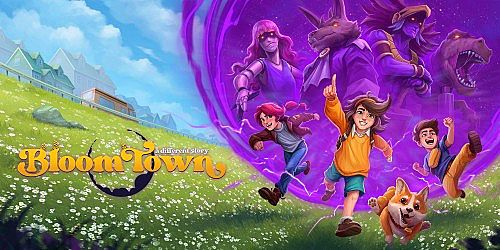




Bloomtown: A Different Story is a narrative JRPG set in a 1960s American small town. Players follow Emily and her younger brother Chester as they spend summer at their grandfather's house and uncover supernatural threats tied to disappearances in the community.
Gameplay
The core loop alternates between everyday life in Bloomtown and expeditions into the Underside, a parallel realm filled with demons born from residents' fears and vices. Days progress through a cycle that limits activities, encouraging choices about how to spend time before night falls or new investigations begin.
In the town, Emily builds four social stats through repeated actions: Charm influences interactions with adults, Guts supports bolder decisions, Smarts aids problem-solving and knowledge checks, and Proficiency covers practical tasks. These stats improve via dice-roll outcomes during conversations or challenges. Available pursuits include working shifts at the local grocery store for pocket money, training at the gym, tending a garden to grow ingredients, crafting tools and lockpicks in a workshop, reading books, solving scattered crossword puzzles, and completing side tasks for townsfolk that also raise stats.
Combat takes place in the Underside dungeons. Encounters appear as visible silhouettes on the field rather than random battles. Each party member possesses a fixed guardian demon that levels up and learns new spells, plus space to equip one additional captured demon for extra skills and stat boosts. Battles are strictly turn-based, with melee strikes effective only against nearby foes, ranged weapons like guns consuming limited ammunition per fight, and elemental magic covering fire, ice, electric, wind, poison, and curse affinities. Weakness exploitation creates openings for follow-up attacks or capture attempts. Weakened demons can be subdued through a dice roll tied to social stats, after which they join the roster or feed into a fusion system that strengthens kept creatures. Dungeons feature room-based layouts with keys, simple puzzles, and chests, though enemies respawn only on subsequent visits rather than within the same trip.
Game Modes
The game operates entirely in single-player mode with no multiplayer options. Progression follows a linear story divided across acts, each centered on a main investigation that leads into one or more Underside dungeons. Side content consists of optional bonding quests with friends that unlock passive combat perks, plus repeatable town activities that feed into the same stat and resource systems used for the main narrative. There are no separate difficulty modes beyond the initial Normal and Hard selections, and no time-limited events or seasonal content.
Story and Setting
The narrative unfolds in a seemingly idyllic 1960s town where adult oversight falters against emerging threats. Emily's group of friends joins the effort after she forms a pact that grants access to the Underside. The story explores themes of hidden vices and community responsibility through dialogue choices and character-specific quests. Dungeons advance the plot by revealing clues about the disappearances, while town life provides context and lighter moments through everyday interactions.
Is It Worth Playing?
Reception has been generally favorable, with critic scores averaging in the mid-70s to low-80s range across major outlets. Reviewers highlight the effective mix of cozy daily routines and tense combat, along with the distinctive pixel art and soundtrack. Playtime for a focused main-story run falls around 17 hours, while thorough exploration of side quests, crafting, and collection extends to 30 or 40 hours. The game suits players who appreciate turn-based JRPG combat paired with social simulation elements and monster collection in a compact package. Those seeking deep strategic complexity or extensive post-game content may find the systems more straightforward than some genre peers. It remains available on Nintendo Switch with periodic updates addressing balance and features since its September 2024 release.