


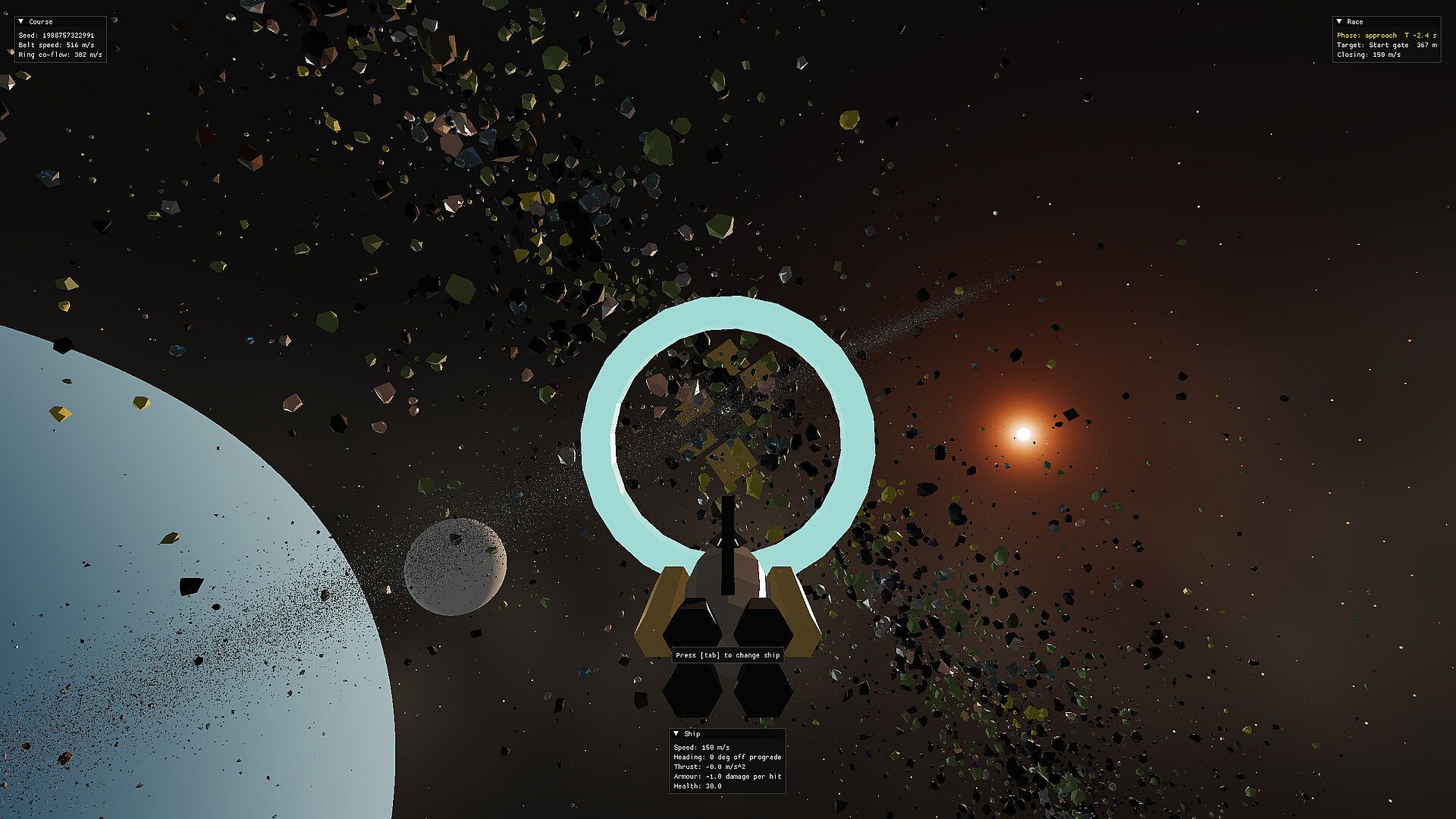
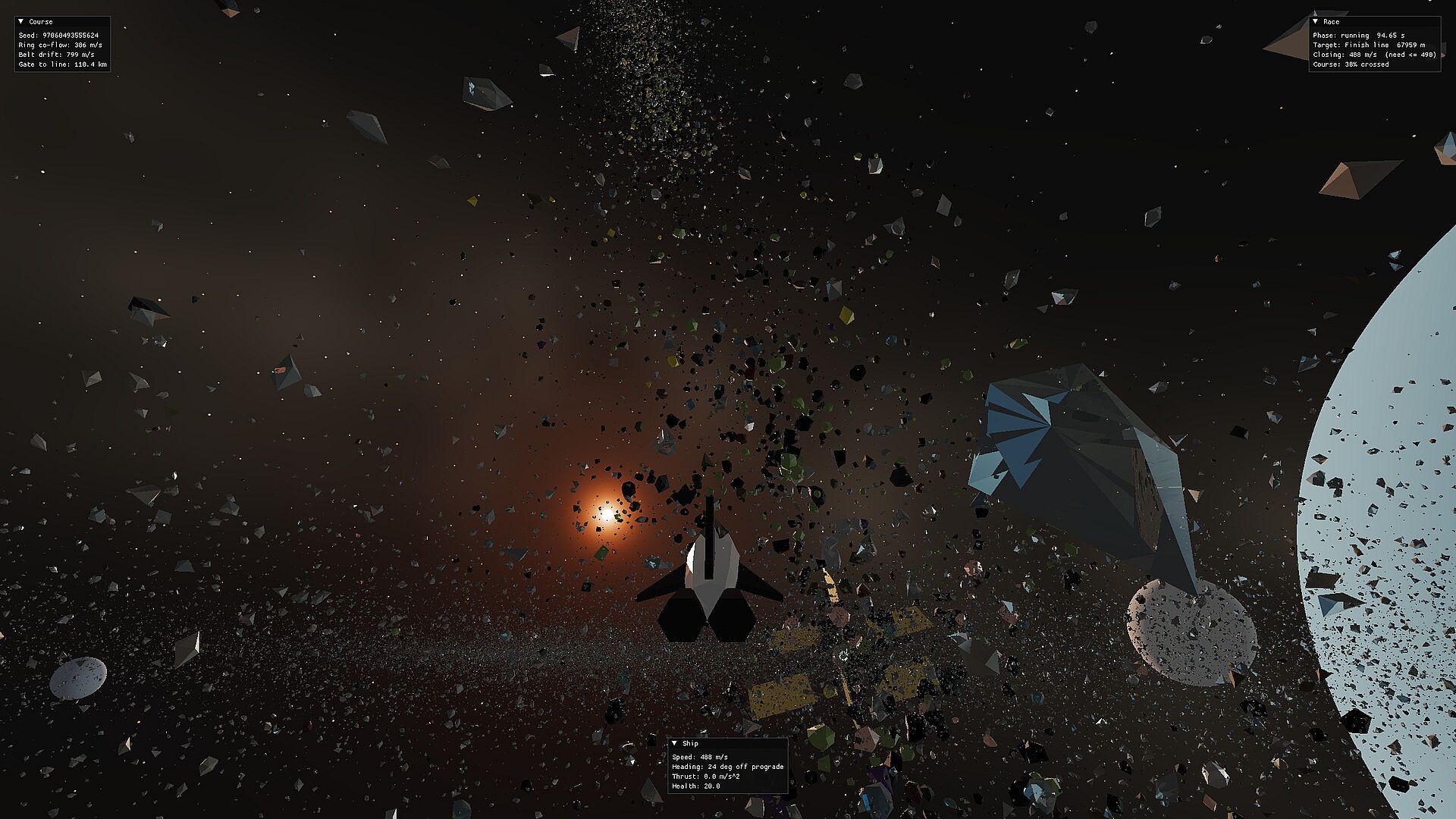
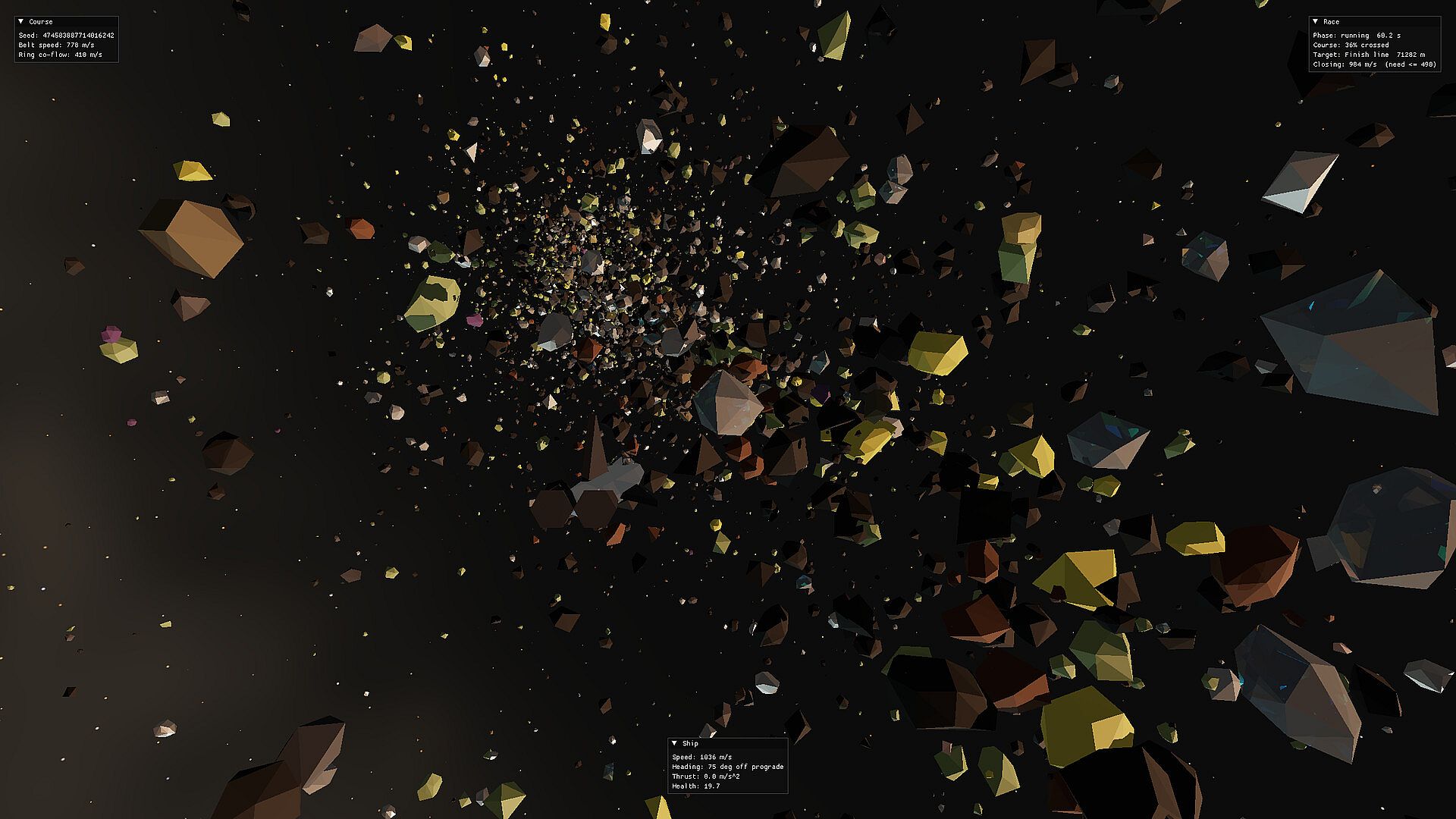
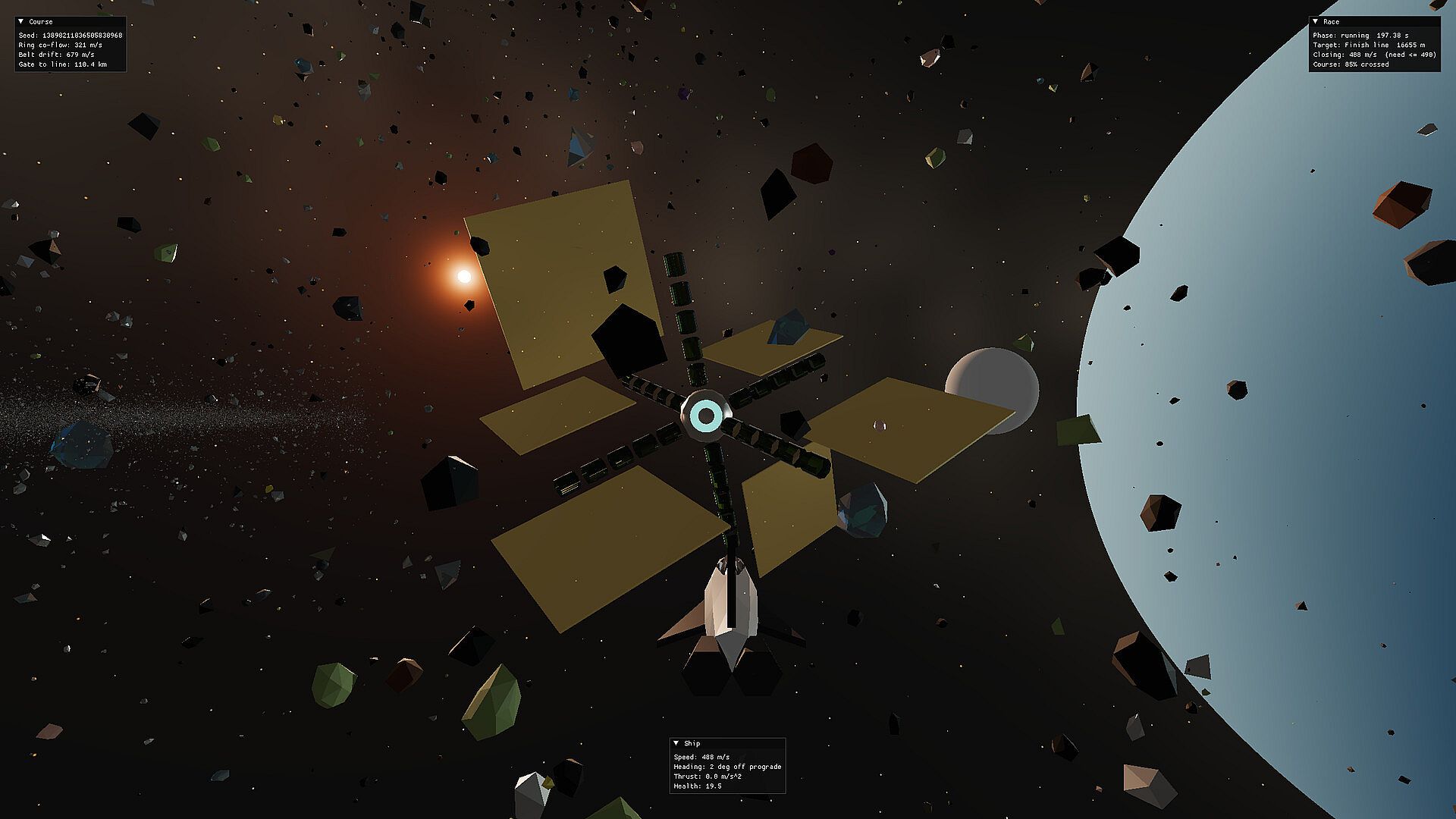
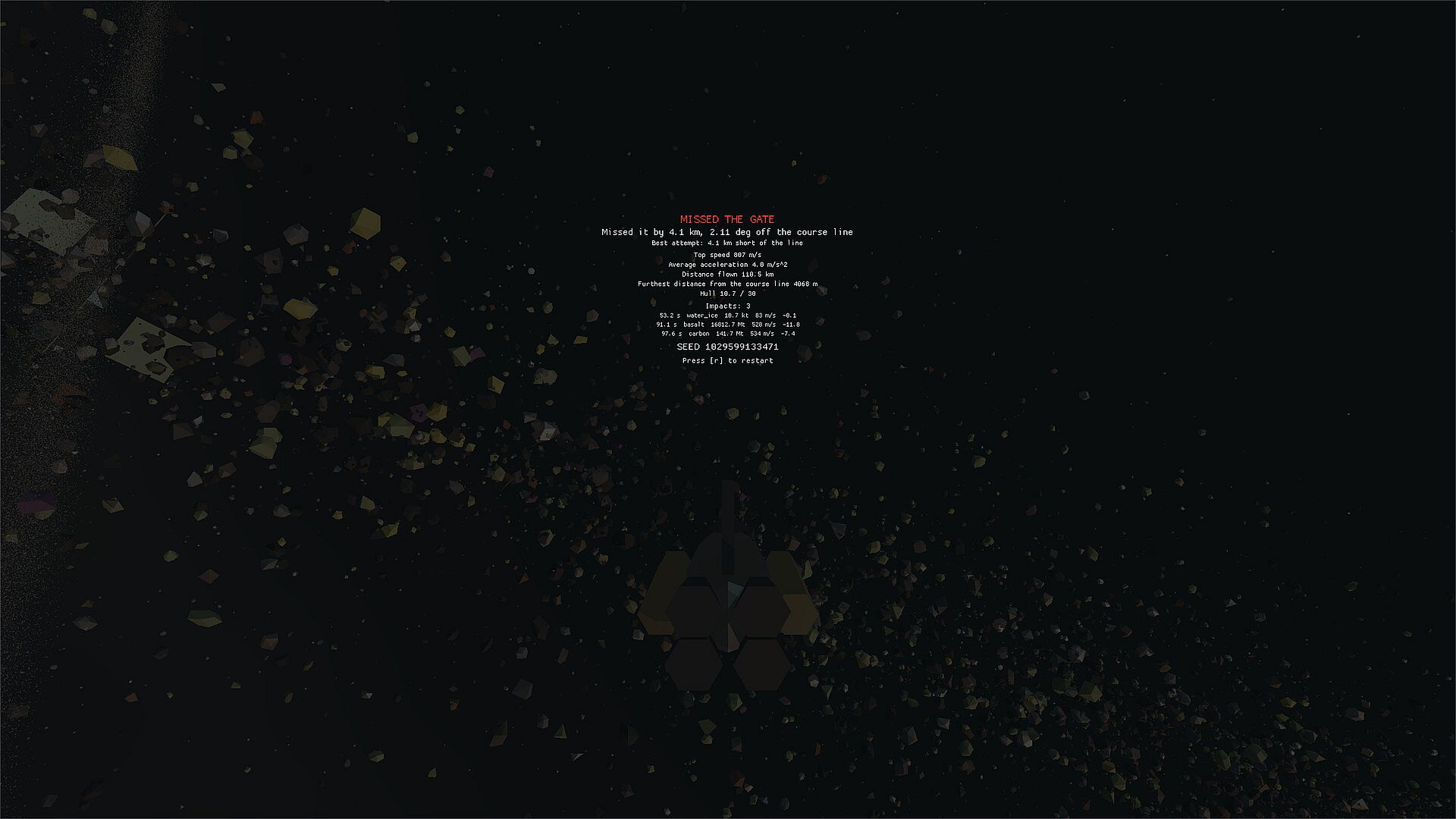
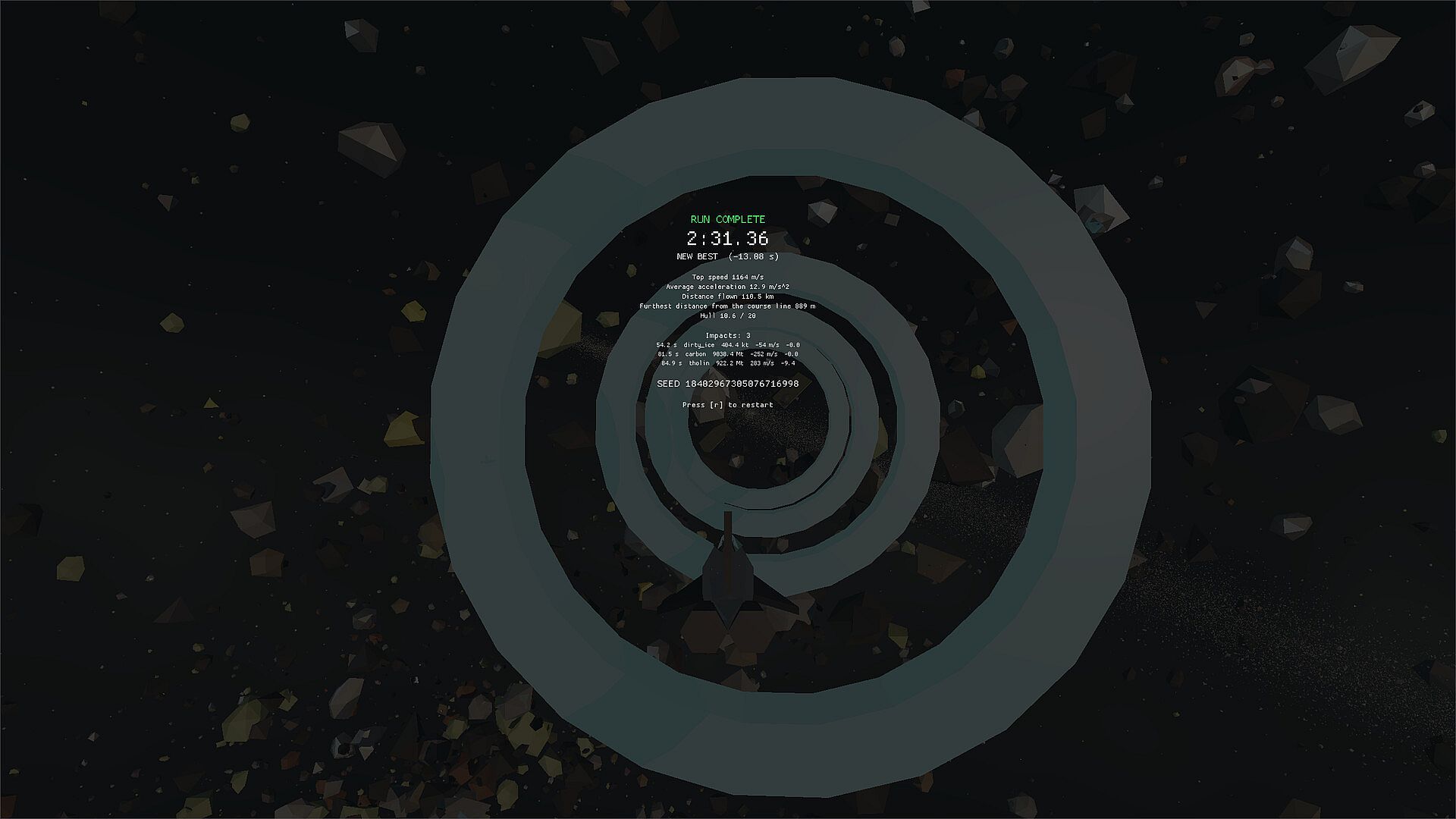
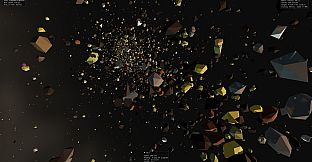
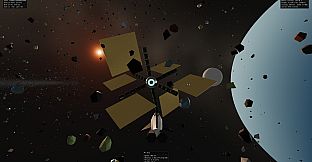


Ionic Drive is a PC racing game centered on piloting a high-acceleration spaceship through a dense asteroid belt that intersects with a planetary ice ring. Players must thread precise paths, execute flip-and-burn maneuvers, and decelerate accurately to dock at a distant station while avoiding hull-damaging collisions.
Gameplay
The core loop revolves around sustained high-speed navigation under extreme conditions. Ships push beyond 2Gs of acceleration, demanding constant adjustments to trajectory. A single degree off course can send the vessel past the docking gate, and insufficient retrograde burns at the end fail to register a successful run. Collisions with asteroids or ice chunks destroy the hull quickly, making every second of flight a test of timing and spatial awareness.
Physics drive every interaction. Objects behave according to real-world material properties, with unified simulation and rendering pipelines handling hundreds of thousands of elements simultaneously. The experience stays minimal by design, stripping away extras to focus on the raw demands of control and prediction. High minimum specifications stem directly from the need to maintain 60 frames per second while processing extensive object counts and leveraging Vulkan 1.4 with hardware ray tracing for all non-UI visuals.
Multi-threading keeps the CPU fully engaged, while memory usage remains compact. All assets are generated programmatically, resulting in a compact executable. These technical choices support the dense, dynamic environment without relying on pre-baked elements.
Game Modes
The initial release centers on a single, self-contained challenge that combines navigation, precision braking, and docking. Success requires completing the full sequence without excessive damage or missed gates. Repeated attempts refine technique, with failure states teaching the exact tolerances needed for victory. No additional named modes appear in the current build, keeping emphasis on mastering this core sequence.
Future updates may expand options, though the developer has stated that post-release additions will arrive gradually. The present version delivers a near-complete experience built around these physics-driven runs.
Technical Foundation
Ionic Drive runs on a custom engine named PlayPhys. This foundation handles both physics calculations and rendering in a tightly integrated system. Objects derive appearance and behavior from real material data, creating consistent interactions across the asteroid field and ice ring. The engine prioritizes performance on capable hardware, enabling the scale of simulation required for believable space debris density.
Development continues with incremental improvements, particularly to collision response. Audio remains absent in the initial version. The binary size stays under 9 megabytes thanks to fully procedural content generation.
Is It Worth Playing?
Ionic Drive suits players who seek demanding, skill-based challenges in a racing context. The satisfaction of a clean run through the hazardous corridor stems from precise execution rather than unlocks or variety. Those who appreciate minimal interfaces and direct physics feedback will find the experience rewarding on hardware that meets the demanding specifications.
Current support focuses on gradual refinements after launch. The game stands as a complete package for its intended audience, with the developer noting that opinions formed at release are unlikely to shift dramatically later. It appeals most to enthusiasts of hardcore piloting simulations who value technical depth over broad accessibility or frequent content drops.