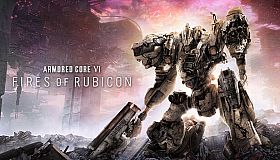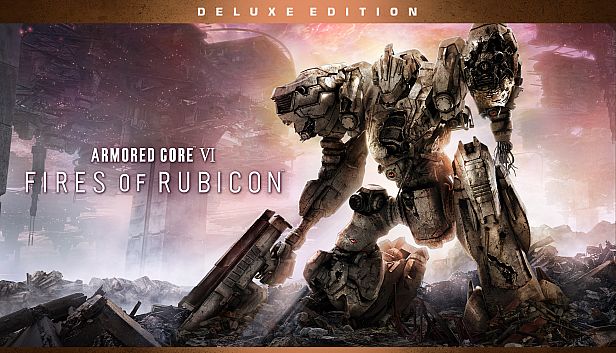



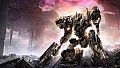
Armored Core VI: Fires of Rubicon is a third-person mech action game in which players pilot customizable Armored Cores through mission-based combat on the planet Rubicon 3. The title emphasizes fast-paced, omni-directional battles that combine ranged firepower, melee strikes, and high-mobility maneuvers enabled by boosters. Players take contracts from various factions locked in conflict over a volatile substance called Coral, completing objectives that range from destroying installations to defending targets or gathering intelligence.
Gameplay
Core combat revolves around assembling and piloting an Armored Core equipped with up to four weapons, two mounted on the arms and two on the shoulders. Parts selection affects weight, energy consumption, speed, defense, and handling, forcing trade-offs that shape each build. Movement relies on standard boosts for jumps and hovers plus an Assault Boost that closes distances rapidly for aggressive approaches or quick repositioning. Encounters unfold across large, multi-layered environments where verticality and speed matter as much as weapon choice. Missions feature varied layouts and enemy compositions, with success measured by completion time, damage taken, and other performance metrics that influence rankings on replays.
Stagger mechanics add layers to fights, rewarding precise timing to break enemy posture and expose vulnerabilities. Players can switch loadouts between missions or even mid-campaign after acquiring new parts, encouraging experimentation. The absence of a traditional leveling system keeps focus on mechanical skill and loadout tuning rather than numerical progression. Boss encounters demand adaptation, as many feature distinct attack patterns and phases that punish static strategies.
Game Modes
The single-player campaign consists of a series of structured missions divided across chapters. Branching decision points appear at key moments, where selecting one contract locks out the alternative for that playthrough and influences later events and endings. New Game Plus expands options with additional missions and further branching paths. An Arena mode, presented as a combat aptitude evaluation program, pits the player against a roster of AI-controlled Armored Cores in one-on-one simulations. Victories here award OS Tuning chips that unlock system upgrades and abilities.
Online multiplayer supports 1v1 and 3v3 matches in which participants bring their custom Armored Cores. Private lobbies were available at launch, with ranked matchmaking introduced through a subsequent update. These modes operate separately from the campaign and allow direct competition using the same customization tools.
Customization and Progression
Assembly occurs in a dedicated garage interface that displays real-time statistics for speed, stability, and other attributes. Hundreds of parts across categories such as head, core, arms, legs, boosters, generators, and weapons permit extensive personalization limited only by weight and energy thresholds. Unlocks come from mission rewards and Arena performance, steadily expanding available options without gating core systems behind story progress. Replaying missions for higher ranks or S-rank clears provides additional credits and parts, supporting iterative refinement of builds.
Is It Worth Playing?
Reception has been generally positive, with critics highlighting responsive controls, mission variety, and the satisfaction of refining a mech to overcome specific challenges. The campaign delivers a complete, self-contained experience with multiple endings accessible through different choices and New Game Plus runs. Multiplayer adds competitive depth for those interested in player-versus-player combat, though the primary focus remains on solo missions and Arena challenges. The game suits players who enjoy deliberate loadout experimentation paired with demanding, skill-based action. Those seeking ongoing seasonal content or open-world exploration may find the mission structure more linear than expected, while fans of precise mech combat and deep customization will find substantial replay value in optimizing performance across repeated attempts.