







LogicForge is an indie simulation game for PC that challenges players to construct digital logic systems starting from the most basic elements. In this single-player experience, users begin with only NOT and AND gates and progressively create every other component needed for functional computing hardware and software.
Gameplay
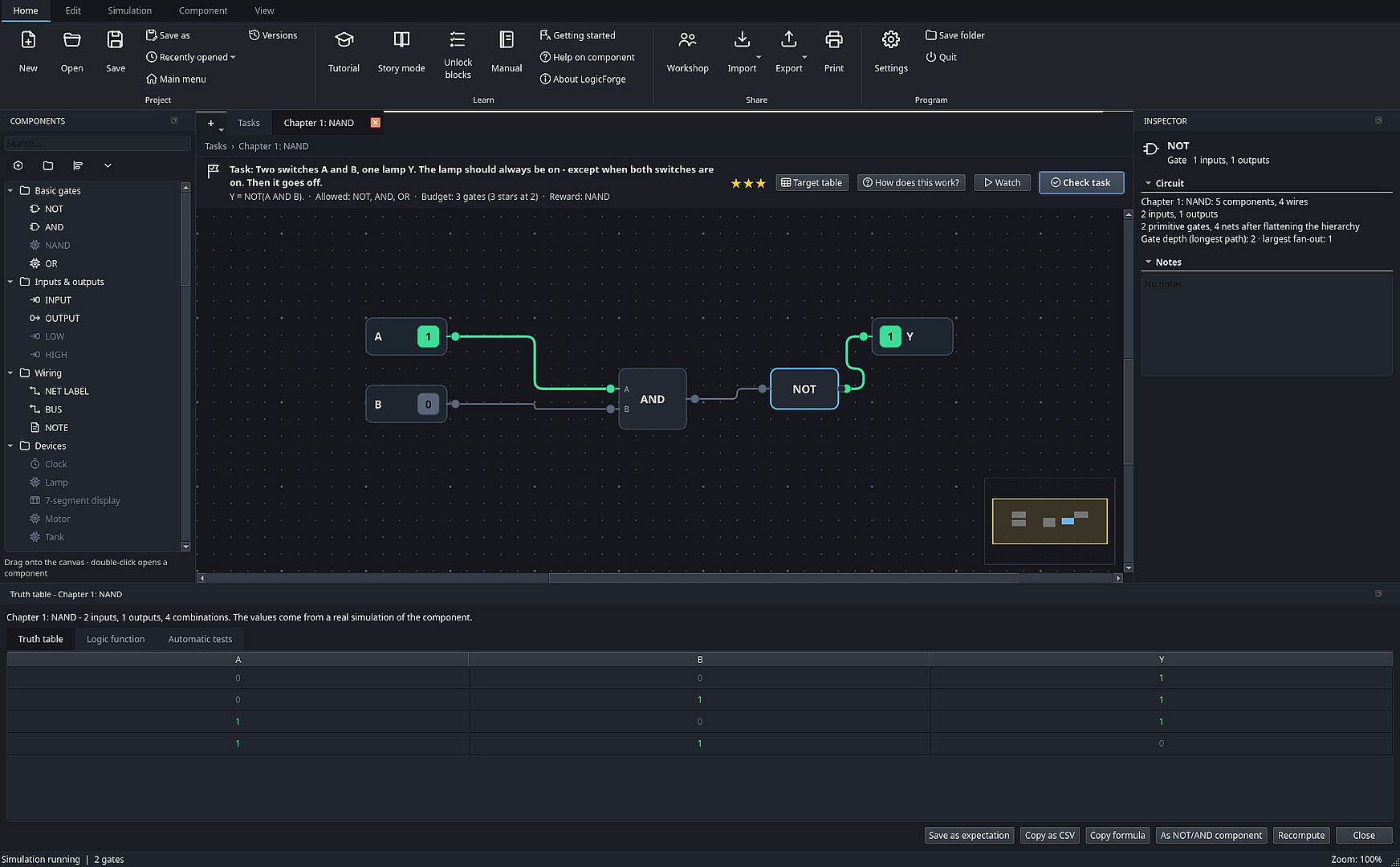
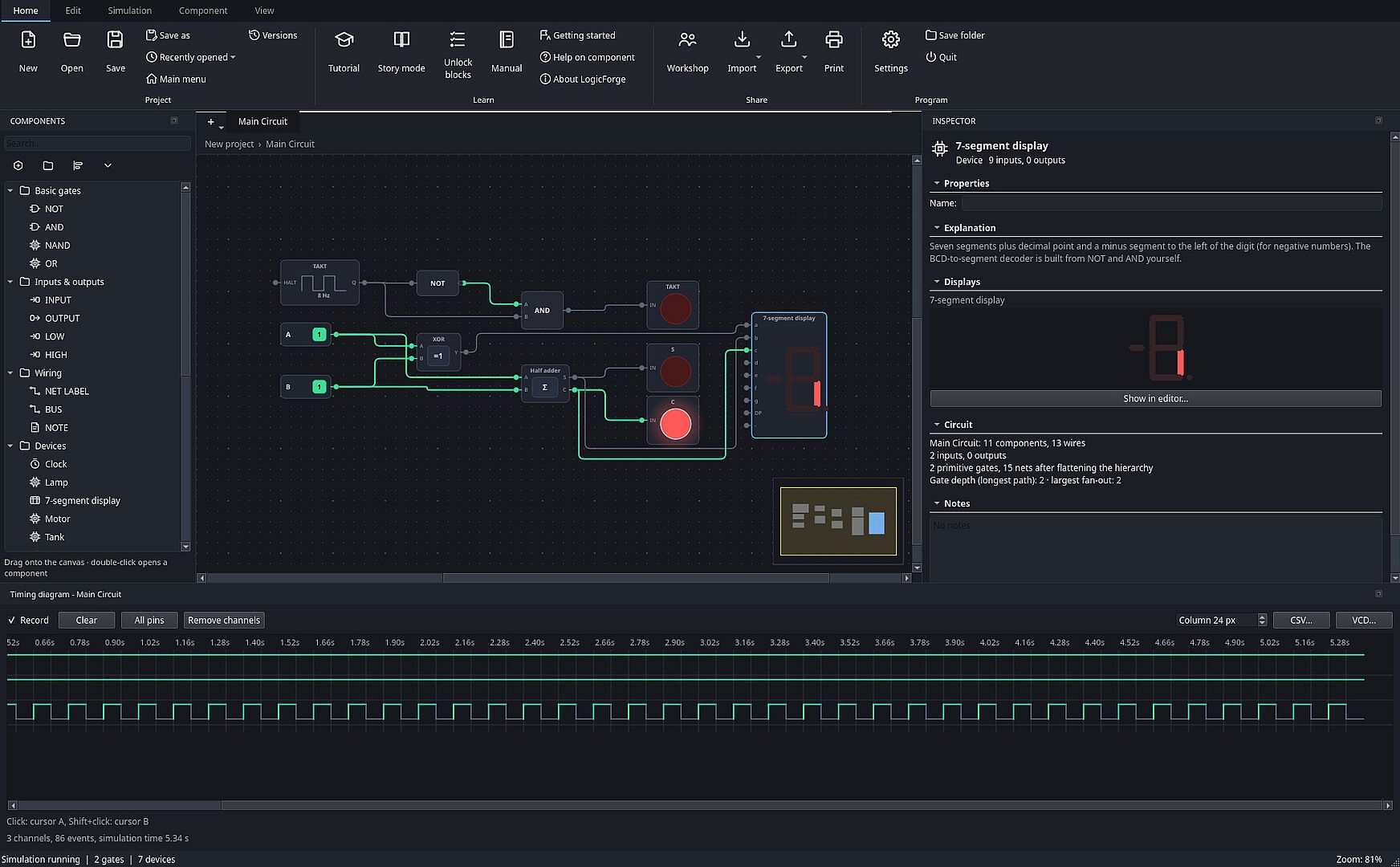
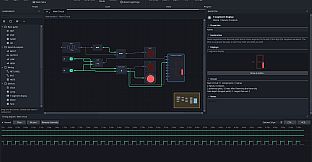
The core loop centers on circuit design and verification. Players connect gates and wires on a grid to meet specific input-output requirements. Solutions are tested in real time, with immediate visual feedback showing signal states as they propagate through the design. Hierarchical construction forms the backbone of progression: any completed circuit can be collapsed into a reusable black-box component stored in a personal library. These custom parts can then be placed repeatedly in larger projects, with the option to expand any instance for inspection of internal signals during simulation.
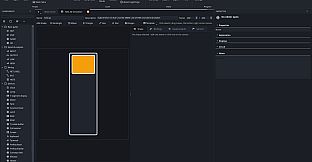
Supporting tools mirror professional workflows. Truth tables display expected versus actual behavior, waveform viewers allow cursor-based timing analysis, and halt conditions help isolate issues in sequential logic. Additional utilities include keyboard and terminal interfaces for input/output testing, RAM and ROM modules, and export options that convert finished designs into Verilog or Arduino-compatible formats. An import feature also accepts files from Logisim, easing transition for users familiar with other logic tools.
Game Modes
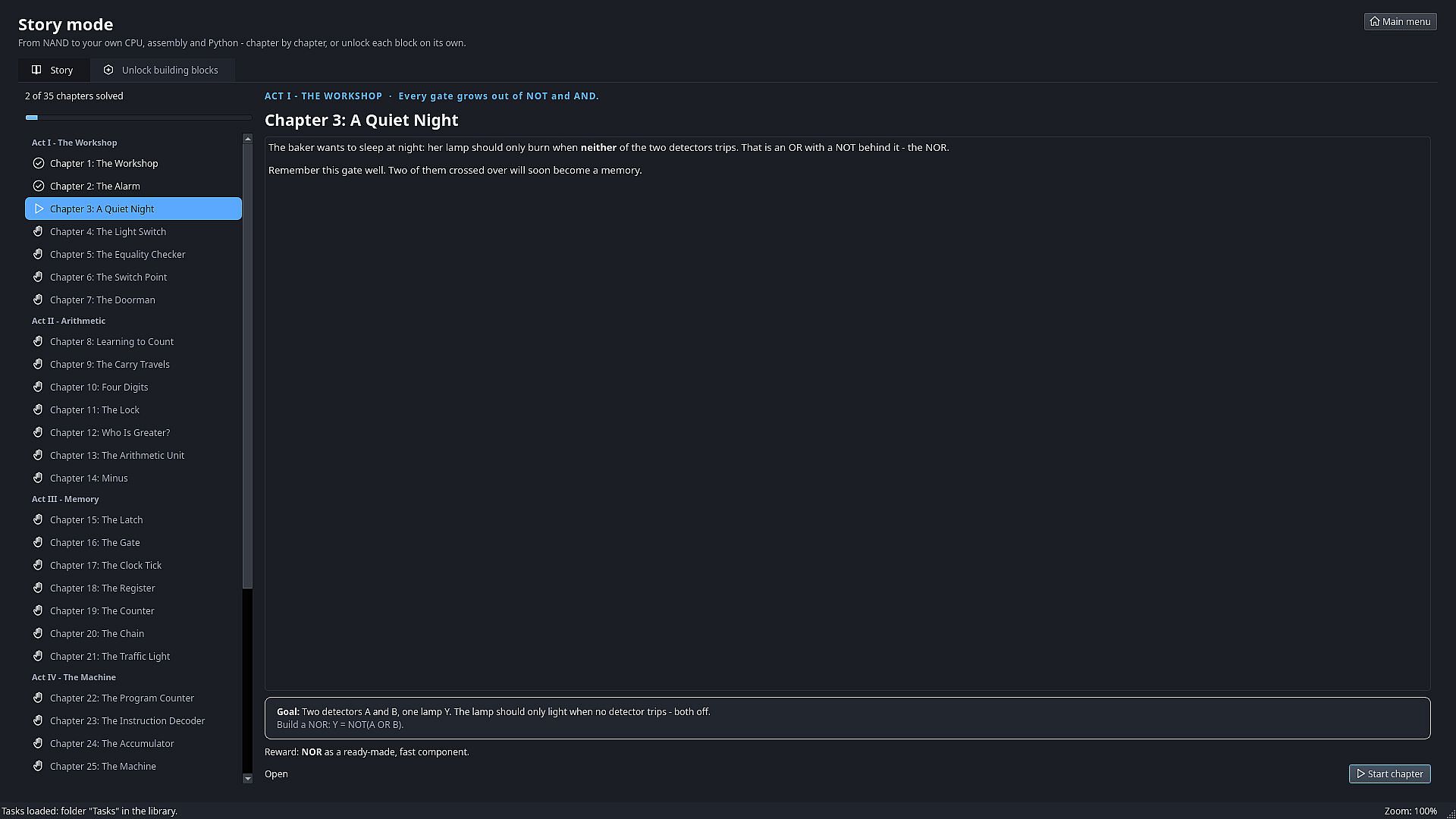
Story mode provides the primary structured path, organized into 102 chapters spread across fifteen acts and three distinct worlds. Each chapter presents a clear objective while leaving the implementation entirely to the player. Stars are awarded based on both functional correctness and efficiency of the solution. Completed blocks, such as OR gates, XOR gates, adders, ALUs, flip-flops, registers, and counters, become permanently available in the library for future use.
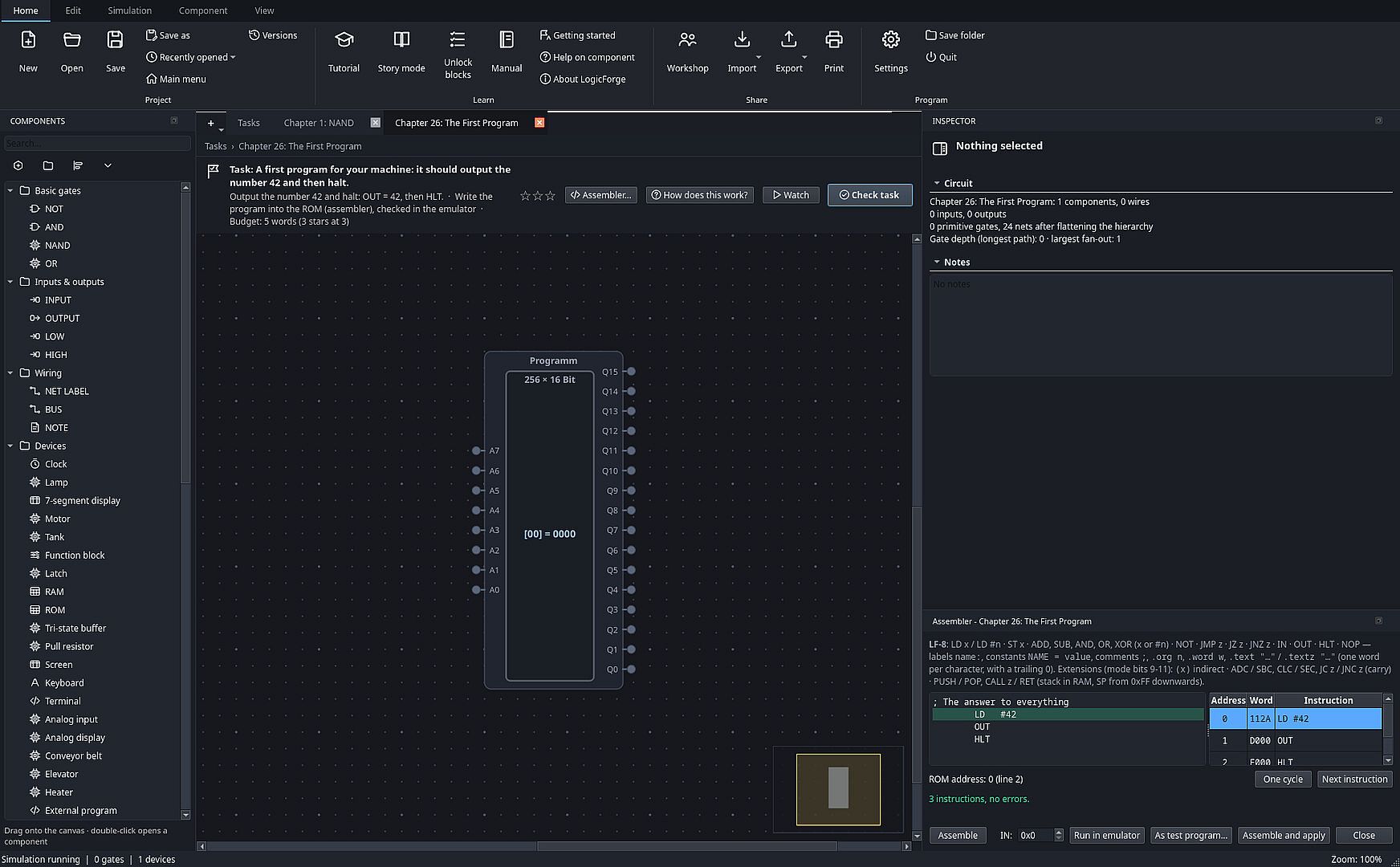
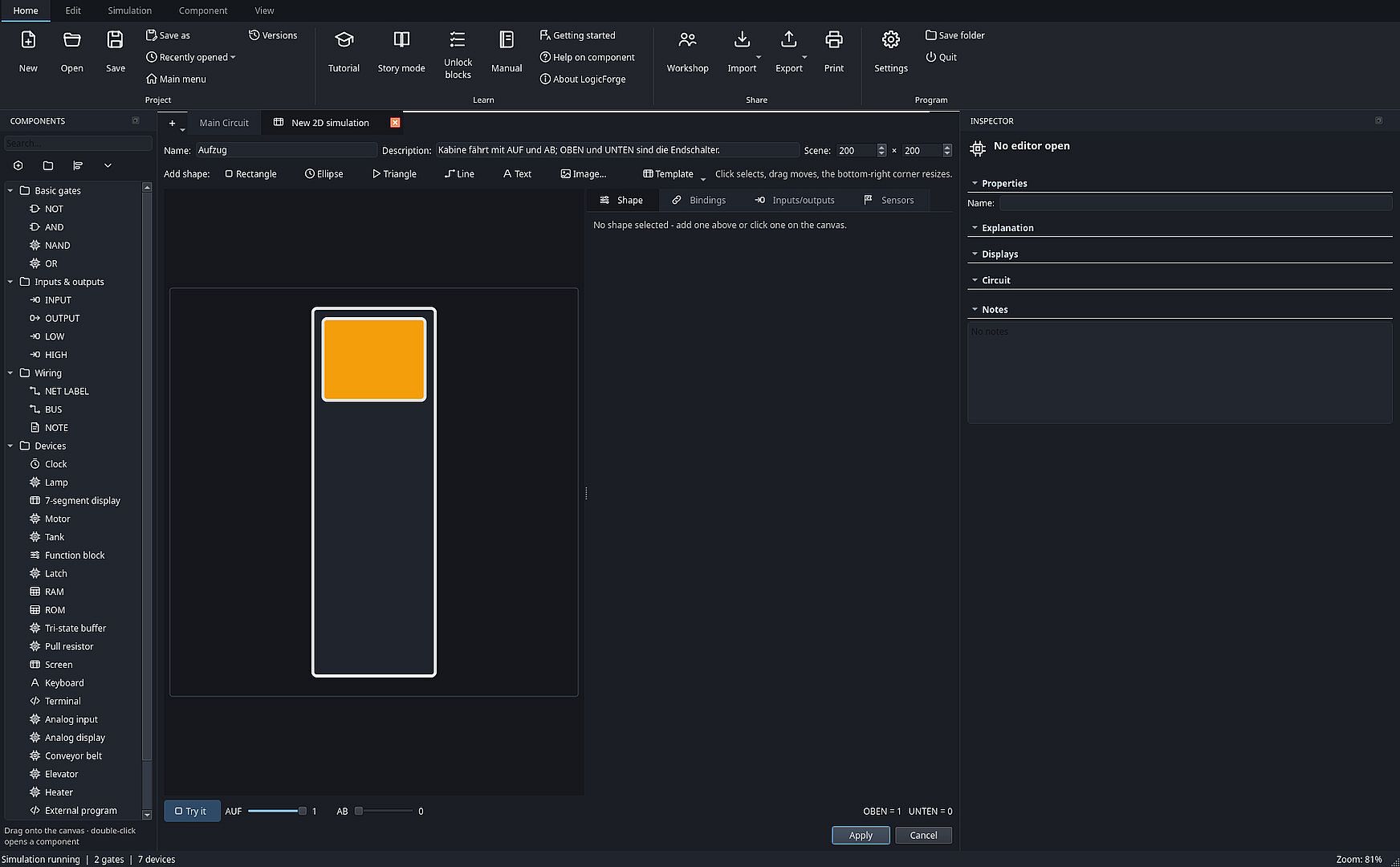
World 1 focuses exclusively on circuits, guiding players from the initial NAND gate through increasingly complex combinational and sequential designs until they have assembled a complete 8-bit CPU. World 2 shifts to assembly programming on the LF-8 processor built in the previous world, covering loops, subroutines, sorting algorithms, and practical applications like controlling a traffic light or elevator. World 3 introduces Python programming from fundamentals, with each chapter delivering one new concept alongside runnable examples and precise output comparison feedback. Scripts created here can later function as control components within animated scenes.
Beyond the campaign, a free-form workshop environment supports experimentation. Players can share custom components, full simulations, and challenge tasks with the community through Steam Workshop integration or simple folder exchange.
Learning Path and Tools
The progression deliberately mirrors real digital design education. Early chapters emphasize gate-level fundamentals and Boolean algebra through direct construction. Later sections layer on sequential elements, arithmetic units, and memory before introducing instruction sets and higher-level programming. This layered approach ensures that every advanced feature rests on components the player has personally verified and optimized.
Live simulation remains central throughout. Values update continuously on the canvas, and nested views reveal internal states without leaving the current context. Economy-focused star ratings encourage compact, resource-efficient solutions rather than brute-force wiring. The combination of guided chapters and open library reuse creates a natural feedback loop where knowledge compounds across worlds.
Is It Worth Playing?
LogicForge targets individuals interested in the foundations of computing hardware and software. Those who enjoy puzzle-solving through logic gates, building systems from first principles, or exploring how processors and programs actually function will find substantial depth. The single-player focus and emphasis on personal discovery suit self-paced learners who prefer constructing solutions rather than following pre-built templates.
Because the game remains in a pre-release state with no user reviews available yet, expectations should center on the documented features rather than community sentiment. Availability on PC with Steam Workshop support positions it well for ongoing community contributions once launched. Players seeking an educational yet hands-on simulation of digital logic and introductory programming will likely appreciate the structured yet open-ended design.












