



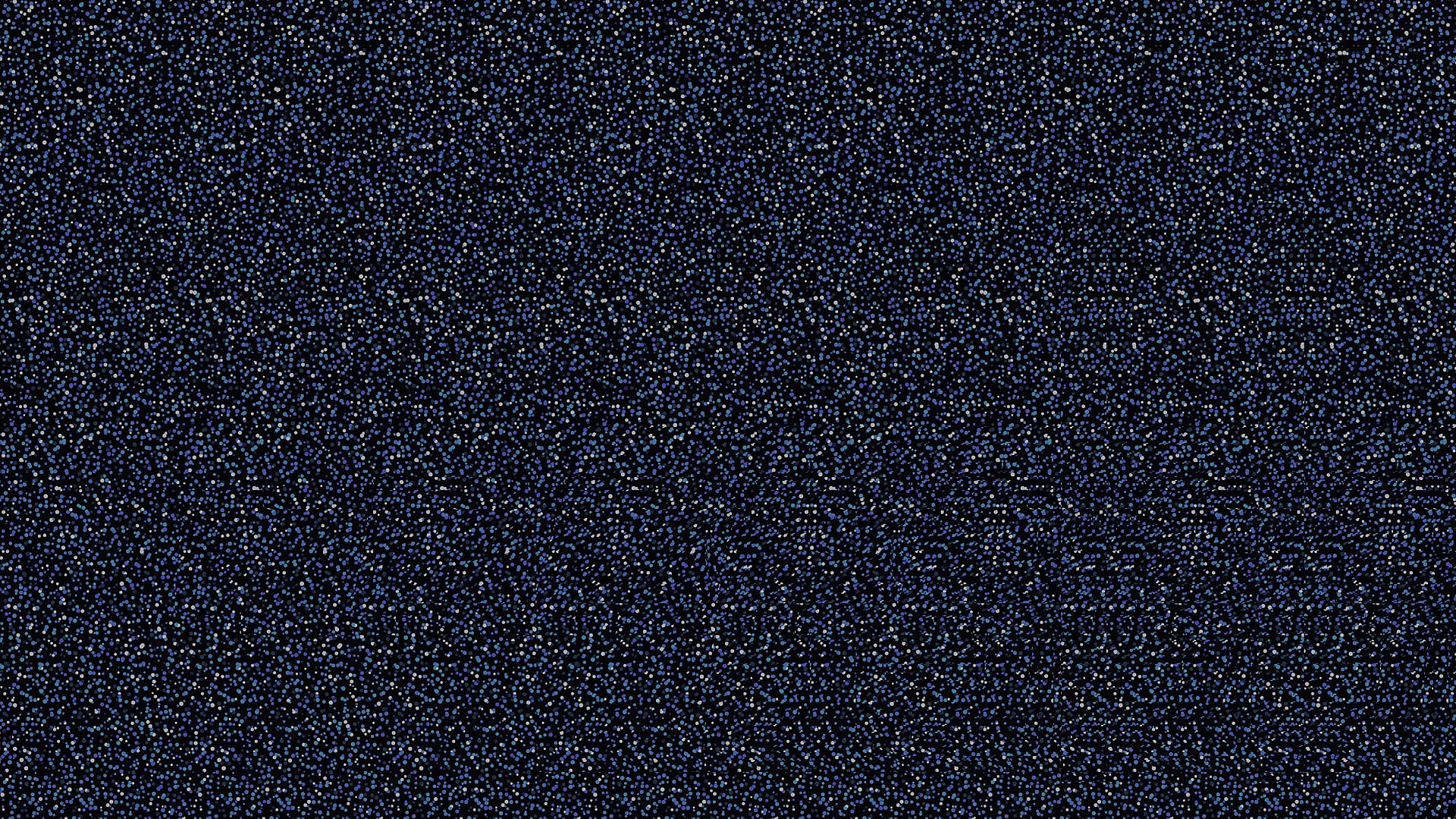








Stereosis is a single-player 3D platformer built around a distinctive visual system. The entire game renders as a real-time autostereogram, the same dot-pattern technique found in classic Magic Eye images. Players must free-view the screen to perceive depth, platforms, enemies, and their own character without any conventional 3D fallback view.
Gameplay
The core loop centers on learning to see the hidden three-dimensional space inside the dot field. Once the image resolves through relaxed eye focus, standard platformer actions become available. Movement occurs on a ground plane with running, jumping, and a double jump that supports variable height. Camera control allows 90-degree rotations at set intervals, which can expose new paths or platforms that remain invisible from other angles.
Levels emphasize spatial reasoning over complex systems. Each stage presents a handcrafted layout where the autostereogram itself forms the primary challenge. Players collect fragments to earn extra lives, displayed as literal cubes within the stereogram. Boss encounters require precise positioning and stomping on weak points rather than any weapon or combat tree. Progress stays linear, keeping attention on the act of fusing the image rather than menu navigation or upgrades.
Full gamepad support enables comfortable play from a couch. The moveset stays deliberately straightforward, matching the feel of earlier three-dimensional platformers while the rendering method adds the constant layer of visual effort.
Game Modes
Stereosis offers a single-player experience with no additional modes or variations. The campaign consists of 36 handcrafted levels followed by boss fights. All content unfolds in sequence without branches, difficulty selectors, or alternate play styles. The design treats the autostereogram rendering as the central mechanic across every stage, so the entire game functions as one continuous test of free-viewing skill and platforming precision.
Visual and Technical Approach
The autostereogram serves as both presentation and puzzle element. No debug camera or assist options exist, forcing reliance on personal stereopsis ability. Later stages build on the 90-degree rotation mechanic to require deliberate world turns that reveal previously hidden geometry. Sound and controls remain secondary to the visual fusion process, with support for multiple languages including English, French, Italian, German, and Spanish.
System requirements stay modest, targeting Windows 10 and 11 machines with mid-range graphics cards. The experience runs entirely on PC and includes Steam achievements for those who complete the levels under the autostereogram constraints.
Is It Worth Playing?
Stereosis targets players who already possess or can develop the ability to free-view autostereograms. Those with vision conditions that prevent stereopsis will find no alternative rendering and cannot progress. For everyone else, the game delivers a focused platformer whose novelty lies in the constant demand to maintain depth perception while executing jumps and rotations.
Because the title remains upcoming with no released version or player reviews available, any assessment rests on the confirmed mechanics. It suits individuals interested in unconventional visual experiments and classic platforming without layered systems or combat complexity. The linear structure and emphasis on seeing the world inside the dots make it a specialized experience rather than a broad appeal title.